Grail: The Notebook Method I Needed
Backstory
For the last few months, I've been struggling unable to keep up my regular Bullet Journaling practice. After years of almost daily logging and journaling (repeatedly broken up by stretches of time in which I fell off the bandwagon), I have pretty much stopped updating my BuJo in mid-2026.1
One of my main motivations to start a regular journaling practice in the first place has been to document my everyday life so my kids will someday get access to a somewhat comprehensive record of my adult life. For this reason alone, my failure to continue this supposedly well-established habit has frustrated me to no end. And of course, the BuJo is where most of my habit tracking, reflections and introspection took place, all of which were invaluable for my personal growth.
It's not that I have stopped using notebooks altogether — to the contrary: I have a pocket notebook with me at all times, and I use several notebooks for different purposes on a daily basis.
Keeping a Bullet Journal has always been not only some kind of hobby or productivity tool, though — it was part of my identity. Whenever I stopped logging more than a few days at a time, I immediately noticed the difference in how I felt; returning to regulary documenting my life never failed to fill me with joy and satifaction. I felt more like myself again.
But this time around, I didn't get back on that bandwagon for so long that the initial frustration and self-loathing hat time to subside to the point where I had to actively remind myself how benefitial journaling has been in the past.
New creative endeavors call for a new system
When searching for the reason why the undocumented days and weeks turned into months this time around, I realized it overlapped almost perfectly with a drastic change I made regarding my writing habits: In late May this year, I announced on my newsletter that I would stop publishing a new text every two weeks, which had been my schedule for almost 80 issues. Instead, I now allow myself to indulge my newly-found interest in long-form essays, and give myself the space and freedom to work on a new piece of writing for as long as it takes to finish.
Once I connected those two dots, the bigger picture started to make more sense. I still want to document what happens to me, and I still want to reflect on the highlights and setbacks of my life. I still want to grow as a person, and I still consider journaling to be an indispensable tool on that journey. I just don't want to cram my introspection together with bullet points about how I went grocery shopping or managed to put my kids to bed without falling asleep myself.
One other strong indicator that I'm on the right track here is that my peaked interest in long-form writing as a means of thinking has led to a concrete dilemma in my journaling and note-taking practice which I described in "The Extended Mind's Extension":
"[...] whenever some thought or problem or idea becomes impossible not to think about, I have to chose between thinking on paper in my regular Bullet Journal or taking notes in preparation for extensively writing about the topic — because that's what I'll end up doing anyway if the topic is complex and intriguing enough."
This is where my ruminations about how to continue my introspective and intellectual work had arrived at — until now.
Enter "The Grail Method" of note-taking.
In one of those rare moments where the algorithm gods seem to care about an indivual fate, my YouTube feed recently featured a video of content creator Perry Daniels in which he introduces a very simple note-taking practice that he called "The Grail Method".2 Here are the key ideas:
- One notebook for (almost) everything! (that you might want to review or use later)3
- No reserved empty pages for possible additions to notes you've already taken. The next entry is written on the next empty page.
- Review the notes in this notebook regularly and often!
- The goal is to maximize creative insight and prepare creative output organically by finding new and surprising connections between unrelated notes and entries. This is not a productivity tool.
This, my dear reader, might be it — the all too simple, yet effective way of combining and consolidating the regular record of my days and weeks, my reflections and introspection from my Bullet Journaling with all the thinking-on-paper, the collecting of quotes and ideas, first stabs at what might become an essay and so on.
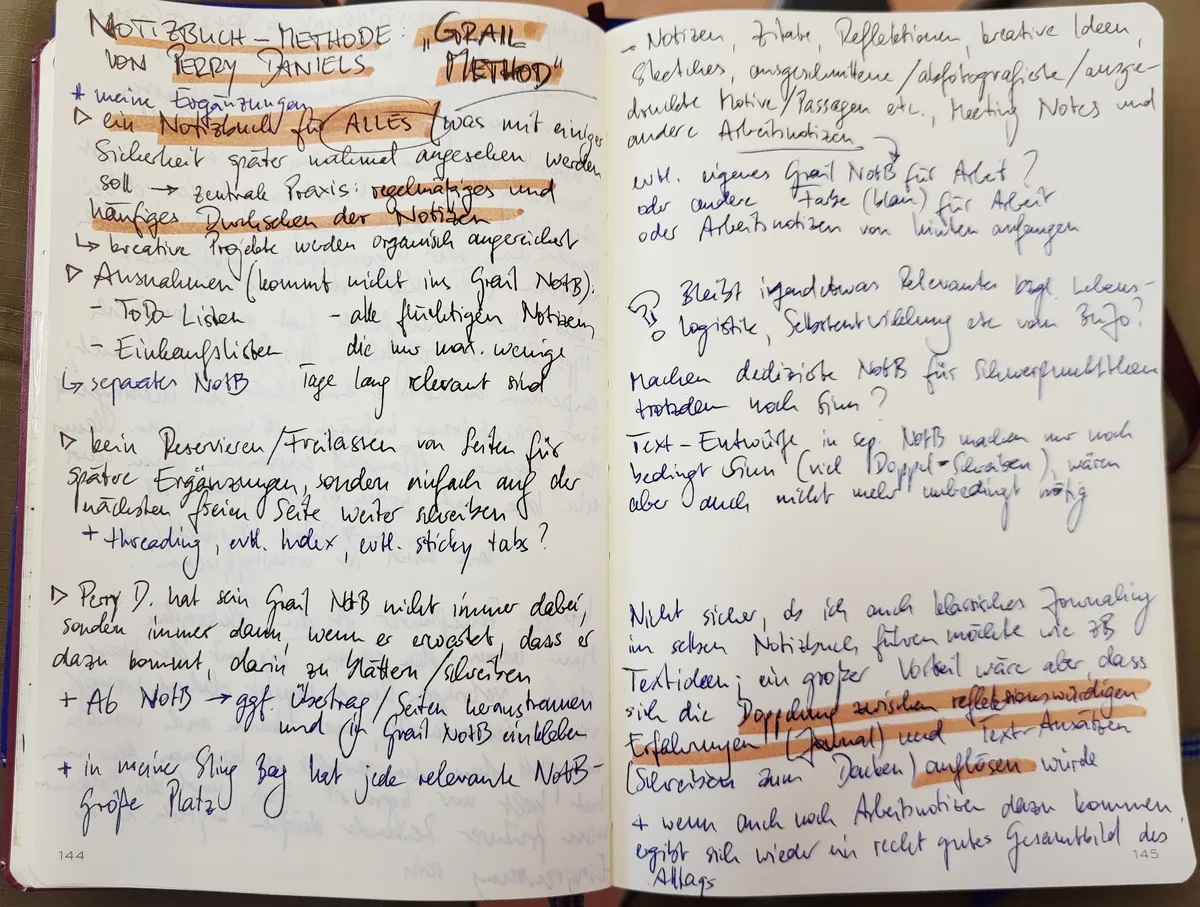 My first notes on the grail method (with my own additions and thoughts in blue)
Making it my own
Of course, any journaling or note-taking enthusiast like myself will recognize that putting almost everything in one notebook comes with its own challenges and downsides:
- What about organization and retrieval?
- What about the form factor (portability vs. real estate for thinking)?
- Do I really want project or meeting notes somewhere between a poem, a recipe and a highly personal journal entry?
This is where some experience with analog notebooks helps. I immediately started thinking about possible or neccessary adjustments, additions and ammendments to the Grail method from my current practice — and I found promising solutions for every possible problem I could imagine.
Here are a few first ideas:
- For organization and retrieval: Threading4, dedicated indices, possibly sticky tabs
- work notes in a different colour that everything else (I already do this in my BuJo)
- pocket notebook for when I don't have the main notebook at hand (I actually love scrap-booking pages from my pocket notebook into other notebooks)
- Yes, I like the idea of having my work notes in one notebook together with most of my private scribbles, because that helps even something chaotic and unorganized like a Grail method notebook to be a somewhat comprehensive record of my everyday life — the challenges I faced, what I spent my time and energy on, what influenced my mood etc.
- I think there is a natural way of combining parts of my current Bullet Journal method (namely the future log, the monthly and weekly spreads and intentions) with the Grail method (which will turn the bullet list-style daily logs into a full-fletched commonplace book-style collection of ... well, everything — including longhand journal entries, quotes, reading notes etc.)
A few points I'm not yet sure about:
- I am currently using a large B5+ notebook for outlining and drafting my long-form writing — including quotes that I might use and first drafts of whole paragraphs. I can see the value of Perry Daniel's more organic approach to collecting and recombining different notes that are scattered throughout the notebook. And I definitely value the idea of writing down every quote or idea that might become relevant for an essay only once, instead of jotting it down in one notebook and then rewriting it in the separate drafts notebook sometime later. But as I now allow myself to take my time with my writing, I fear that this methodology might lead to me having to flip through at least two of those grail method-notebooks in order to find all the entries that I might need for a particular essay. So I might keep my separate writing notebook around.
- I also have several dedicated notebooks for particularly complex topics that I want to explore over the course of years. There are ways to do that within a system like the Grail method (e.g. keeping a topic-specific index with a list of all the relevant notes throughout all notebooks).
- Maybe the most efficient solution to both these challenges is to use a digital app. I could do both my early-stage writing and my note-taking on particular topics of interest in Obsidian (which I already use). That way, I wouldn't need any other dedicated notebook besides the all-purpose BuJo/Grail.
Parting thoughts
At this point, I'm mostly sold on the idea of incorporating the Grail method into my Bullet Journaling. I'm fully aware that there will be problems I didn't foresee and moments where I will miss my old way of doing things. But I have to make a change in order to get back on track with my journaling. All that's left is to decide when I'm going to make that switch and if I'm taking another run at filling in the missing months first.
I will update this post if neccessary, and of course I will write additional blog posts if there is anything important to report on how it's going.

Footnotes
I have recently started reconstructing the missing weeks and months and adding at least the most important moments and pictures. But with several months to go, it's a daunting task that keeps getting more insurmountable with every passing week.↩
This includes everything that would go in a regular Commonplace Book (like quotes, poems, snippets from conversations, insights, observations etc.) as well as meeting notes from work — and, of course, journal entries. This does not include daily or weekly tasks, grocery lists or any other kind of notes that become irrelevant in a matter of days.↩
Threading, for me, is simply the practice of referring from one collection of notes to another on the same topic by jotting down the respective page numbers. This is even possible between different notebooks by giving each notebooks a distinctive number/name etc.↩